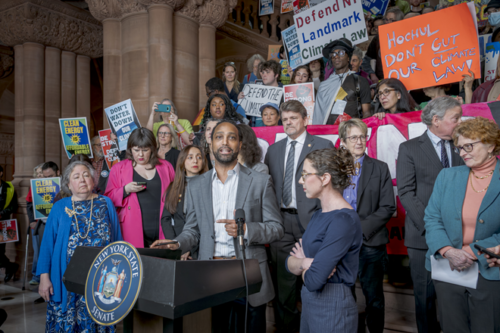
With passage of the New York State Climate Act in 2019, originally known as the Climate Leadership and Community Protection Act, New York State has committed to emissions reductions goals – reduce emissions to 40 percent below 1990 levels by 2030 and then to 85 percent below 1990 levels by 2050 – to address the climate crisis, which is disproportionately impacting communities of color.
New Yorkers are living through a real affordability crisis. One in four households are at least 60 days behind on their energy bills, and nearly $2 billion in utility debt is weighing down families across this state.
Communities of color and low-income face the greatest burden, in terms of both energy costs and air pollution. They often live in older, poorly maintained homes that are among the most energy inefficient. Yet they are required to spend a disproportionate amount of their household income on their energy bills. And in terms of air pollution, studies show that people of color are 1.3-times more likely to die prematurely from air pollution than whites. Ignoring or even postponing the Climate Act’s emissions reduction mandate will lead to more unnecessary deaths across the state.
However, the State has failed to issue the regulations required to implement this law. That is why WE ACT was among the plaintiffs in a lawsuit against the New York State Department of Environmental Conservation. The law requires the State to do so, and after patiently waiting for more than four years, the State opted to ignore the law – so we sued, and the court ruled in our favor. The State has continued to ignore the law and filed an appeal.
Now the New York State Governor, Kathy Hochul, has started peddling a false narrative that energy affordability and climate justice are mutually exclusive. She is using this false narrative in a bizarre attempt to roll back the Climate Act through the State’s budgeting process.
We know that the path to lasting energy affordability is to implement the Climate Act. To achieve this, we recommend New York State adopt these three common-sense pillars to make energy more affordable for working-class families in the short-term while advancing climate justice so the children in those families will be able to live in a cleaner, healthier environment:
1) Sustainable Future Program
New York needs to renew its $1-billion investment for the Sustainable Future Program. This will lower the financial burden on communities of color and low-income because the combustion of oil and gas is directly linked to increased rates of asthma and respiratory illness, which disproportionately impact communities of color and low-income neighborhoods. It also addresses the environmental hazards that make residents sick in the first place. And it’s a proven ROI – an economic engine, projected to support 7,400 new, good-paying jobs and generate $1.5 billion in economic activity. The Sustainable Future Program provides the weatherization and renewable infrastructure necessary to decouple family budgets from volatile, spiking gas prices that are projected to rise through 2026.
2) GAP Fund
Improving energy efficiency is the quickest, cheapest, and most equitable path to reducing energy bills. Investing $200 million in the Green Affordable Pre-Electrification (GAP) Fund will provide technical assistance and financial support for affordable housing in need of a wide-range of currently unfunded retrofits that prevent families from participating in energy efficiency programs. The GAP Fund will help address deferred maintenance issues and eliminate legacy environmental hazards like lead, mold, old roofs, and poor ventilation. By eliminating the overlapping physical and economic structural barriers to electrification, the GAP Fund is an essential first step to ensuring vulnerable New Yorkers have access to healthy and affordable electrified homes.
3) Empower+ Program
The Empower+ Program has proven to be a successful pathway for low- to moderate-income households to reduce their energy usage and bills. Investing $200 million in this proven program will provide interventions such as air sealing, insulation, and energy efficient heating systems for 30,000 low- and moderate-income households each year. Building off the GAP Fund, Empower+ will help make energy more affordable while reducing the energy we use.