INSIDE THE BEAUTY AISLE: WHAT’S REALLY IN OUR PRODUCTS?
A community-based investigation of ingredients in beauty and personal care products sold in Northern Manhattan
Download the Inside the Beauty Aisle Fact Sheet
Download the Inside the Beauty Aisle Study Report
Using the Clearya Survey app, WE ACT staff and members collected ingredient information from 733 unique beauty and personal care products sold in local beauty supply stores of predominantly Black and Latinx neighborhoods in Northern Manhattan. Product label photos and ingredient lists were analyzed using the Clearya Insights platform to identify chemicals of concern. In this analysis, prioritized chemicals of concern include ingredients linked to health concerns such as cancer, hormone disruption, and reproductive harm, and ingredients restricted or banned in other jurisdictions, among others.
Overall, about 60 percent of products contained at least one prioritized chemical of concern.
This community-supported project engaged local residents in documenting beauty and personal care products sold in neighborhood beauty supply stores across Northern Manhattan.
- Project overview:
- Study area included 4 neighborhoods: Central Harlem, East Harlem, Morningside and Hamilton Heights, and Washington Heights and Inwood
- 15 local beauty supply stores (non-chain retailers) were visited
- 255 brands were analyzed
- 20,172 ingredients were reviewed
- Product categories included:
- General hair care (shampoo, conditioner, styling products, and curl products)
- Hair dye and bleach
- Hair straighteners and relaxers
- Makeup (including lipstick, mascara, and concealer)
- Skin lightening products
Ingredients in beauty and personal care products were screened for prioritized chemicals of concern. Products were then classified into the following categories based on the ingredients identified:
- CMR: Chemicals associated with cancer, DNA damage, or reproductive harm (carcinogenic, mutagenic, or reprotoxic substances). This category includes ingredients classified by authoritative agencies, including known and suspected carcinogens (e.g., IARC Group 2B) and reproductive toxicants (e.g., EU Annex VI CMR Category 2).
- EDCs: Endocrine-disrupting chemicals (EDCs) can interfere with hormone regulation.
- Restricted: Ingredients that are banned or restricted in other regions, including the European Union, Canada, and some U.S. states due to health or environmental concerns. For this analysis, formaldehyde-releasing preservatives were also included based on Washington State’s upcoming restrictions, which take effect in January 2027.
- No PCC: Products that did not contain prioritized chemicals of concern based on the ingredients reviewed. These products may still contain other ingredients of lower concern or ingredients not disclosed on labels.
- Because products may contain multiple ingredients of concern, a single product may fall into more than one category. For example, one product may contain chemicals linked to cancer, hormone disruption, and restrictions in other regions.
Why Beauty Justice Matters: Perspectives from Northern Manhattan
Beauty justice is a framework that centers the right of all people to access safe, non-toxic beauty and personal care products regardless of race, income, or where you live. It recognizes that beauty products are shaped not only by personal choice, but also by systems that influence how products are formulated, marketed, regulated, and sold.
Many beauty and personal care products are used daily and often layered together as part of regular routines, creating repeated opportunities for exposure to chemicals over time. The Environmental Working Group (EWG) found that personal care products marketed to Black and Latina women are more likely to contain chemicals of concern than products not targeted to specific demographic groups. Consistent with these patterns, women of color have higher levels of certain beauty product-related chemicals of concern in their bodies compared to White women, even after accounting for socioeconomic status.
Exposure patterns to chemicals of concern are also shaped by how cosmetic products are regulated in the United States. The U.S. Food and Drug Administration (FDA) has limited authority over cosmetics and does not require most ingredients to be reviewed or approved before products reach the market. As a result, safety oversight is largely left to manufacturers, and federal cosmetic regulations remain less restrictive than in some other jurisdictions, including the European Union and Canada, which restrict or ban over 1,600 cosmetic ingredients compared to fewer than 20 at the U.S. federal level. In response to these gaps in federal regulation, several U.S. states have passed their own cosmetic safety laws. For example, Washington and California have restricted chemicals such as formaldehyde in cosmetics and personal care products. New York State’s proposed Beauty Justice Act (S.2057/A.2054), also known as the Safe Personal Care and Cosmetics Act, would further restrict some of the most harmful chemicals linked to cancer, reproductive harm, and hormone disruption.
Prior research, including WE ACT’s Beauty Inside Out study, highlights how beauty and personal care product use among women of color are often shaped by Eurocentric beauty standards and colorism. Products such as hair straighteners and relaxers and skin lightening products reflect these beauty standards and have been found to contain toxic chemicals such as formaldehyde and mercury.
This community-supported project examined beauty and personal care products sold in Northern Manhattan to better understand the chemicals present in products available in the local retail environment. Identifying which products are sold in local stores is an important step toward increasing transparency, supporting informed consumer choices, and advancing beauty justice.
Findings
What did we find on store shelves?
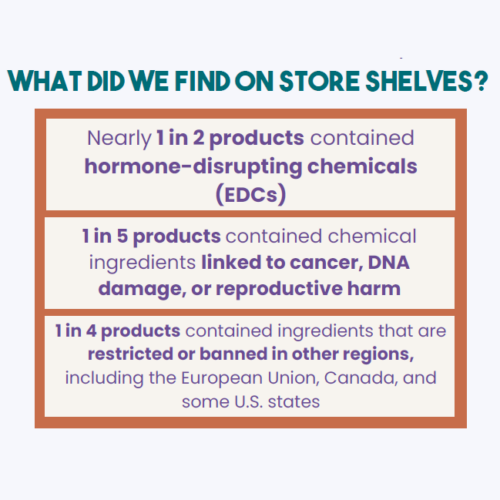
Nearly 1 in 2 products contain endocrine- or hormone-disrupting chemicals (EDC)
Endocrine-disrupting chemicals can interfere with the body’s hormone system and have been associated with health concerns including fibroids, early puberty, infertility, and certain cancers. Research in the United States suggests that exposure to certain EDCs may be higher among non-White populations and may contribute to racial and ethnic disparities in women’s reproductive health outcomes, including conditions that disproportionately affect Black women such as fibroids.
1 in 4 products contained ingredients that are restricted or banned in other regions, including the European Union, Canada, and some U.S. states
These ingredients are restricted or banned in the European Union, Canada, and certain U.S. states, but none were prohibited under current U.S. federal cosmetic regulations. These differences highlight how cosmetic ingredient safety standards vary across regulatory systems.
1 in 5 products contain CMR ingredients – chemicals known or suspected to be linked to cancer, DNA mutations, or reproductive harm.
These chemicals were most commonly found in certain product types, including hair dye, hair straighteners and relaxers, and skin lightening products.
What types of products contain chemicals of concern?
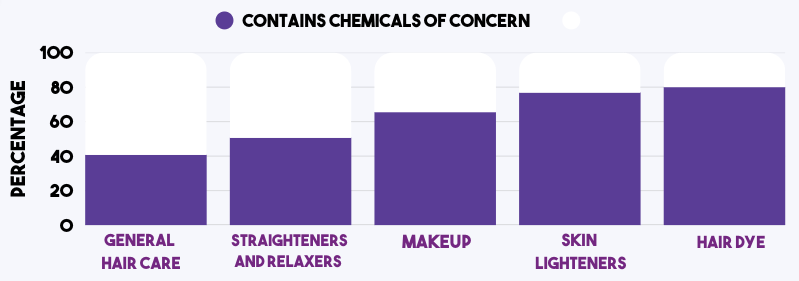
Prioritized chemicals of concern were found across all product categories, showing that exposure potential is widespread across different types of beauty and personal care products. While levels varied by product type, hair dye and bleach products showed the highest presence, and general hair care products showed the lowest. Even in the lowest category, a substantial share of products, about 40 percent, still contained prioritized chemicals of concern.
Eighty percent of hair dye and bleach products scanned contained at least one prioritized chemical of concern, the highest proportion of all product groups. This is especially concerning as hair dyes are often used repeatedly and over long periods of time and may contain ingredients associated with cancer, hormone disruption, or reproductive harm. These findings are consistent with recent testing by Consumer Reports that found toxic chemicals in all 23 at-home hair dye products tested, including methylene chloride, a probable human carcinogen, and benzene in hair chalk products marketed to children.
About 76 percent of skin lightening products scanned contained at least one prioritized chemical of concern.
Skin lightening products are commonly marketed using terms such as “brightening,” “correcting,” “even tone,” or “fading.” The World Health Organization (WHO) has reported that some skin lightening products sold globally may contain mercury that is typically not disclosed on product labels. Mercury-containing products have been banned or restricted in many countries and are associated with kidney damage, skin rashes, neurological effects, and psychological symptoms such as anxiety and depression. WE ACT’s Beauty Inside Out survey found that some women of color associated lighter skin with beauty, youth, and social acceptance, while most did not personally endorse these beliefs but reported that they believed others in society do. These perceptions reflect externalized social pressures shaped by long histories of racism and colorism that continue to influence beauty standards globally.
What chemicals of concern were found in each product type?
To better understand exposure patterns, we examined how often different types of chemical hazards appear within each product category. This analysis focuses on three groups of chemicals of concern: carcinogens, mutagens, and reproductive toxicants (CMRs); endocrine-disrupting chemicals (EDCs); and ingredients restricted or banned in other regions. These categories were selected because they are widely used in cosmetic safety research to identify ingredients linked to health risks and regulatory concern.
Each percentage shows how many products in a given category contained at least one chemical in a specific hazard group (CMRs, EDCs, or restricted ingredients), out of the total number of products in that category. Because products may contain multiple chemicals of concern, they can be counted in more than one hazard group.
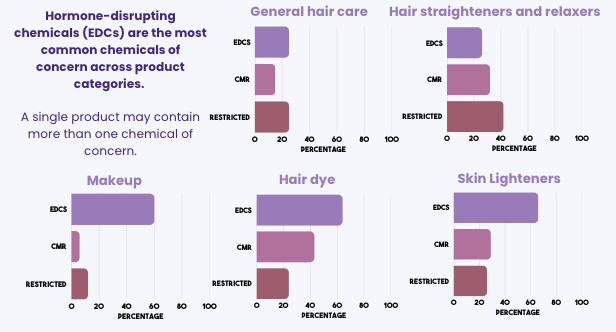
Endocrine-disrupting chemicals (EDCs) are the most widespread hazard type across categories including skin lightening products, makeup, hair dye, and general hair care. Hair dye and skin lightening products show higher concentrations of chemicals linked to cancer and endocrine disruptors.
Which brands appeared most often in products with chemicals of concern?
Among the products scanned, we identified brands that appeared most frequently in products containing at least one prioritized chemical of concern. This reflects findings from the stores included in this project and does not represent a ranking of overall brand safety.
- Nicka K New York
- Kiss
- Creme of Nature
- Ruby Kisses
- Absolute New York
Across all brands in this study, endocrine-disrupting chemicals (EDCs) were the most commonly identified chemical group. While some products contained multiple hazard types, others contained no prioritized chemicals of concern, showing that different formulations exist within the same brand lines.
What kinds of chemicals did we find in beauty and personal care products in Northern Manhattan?
Across beauty and personal care products analyzed in Northern Manhattan, we identified commonly occurring chemicals of concern and recurring groups of ingredients used for preservation, fragrance, hair coloring, UV protection, and product texture. Rather than examining individual chemicals in isolation, we grouped them into chemical families to better understand how exposure appears across everyday products.
Common types of chemicals found in products include:
- Preservatives (Parabens)
- Common parabens identified included methylparaben, propylparaben, butylparaben, and ethylparaben. Parabens are used to prevent bacterial growth and extend shelf life. Some have been studied for their potential to interact with the hormonal system.
- Hair dye and color-developing chemicals
- Resorcinol and 4-aminophenol were among the most frequently identified hair dye and color-developing chemicals. These ingredients are used in permanent and semi-permanent hair dyes to create color and have been associated with skin irritation and other potential health concerns with repeated use.
- UV filters
- Octinoxate was one of the most commonly identified UV filters. UV filters are used in sunscreens and cosmetics to absorb ultraviolet (UV) radiation and protect skin. Some of these ingredients are currently being reviewed in different regions for potential health and environmental impacts.
- Siloxanes
- Decamethylcyclopentasiloxane (D5) was a commonly identified siloxane. Siloxanes are used to improve product texture, spreadability, and feel. Some forms are persistent in the environment and are restricted in cosmetics in Europe.
- Research by Toxic-Free Future and WE ACT also identified siloxanes such as D4, D5, and D6 in hair products marketed to Black and Brown women and sold on the Sally Beauty website. These chemicals have been associated in studies with potential health and environmental concerns, raising environmental justice implications related to exposure disparities.
- Fragrance-related and stabilizing compounds
- Lilial and butylated hydroxytoluene (BHT) were among the most commonly identified fragrance-related and stabilizing ingredients. These chemicals are used to stabilize products or create fragrance profiles. Lilial is prohibited and BHT is restricted in Europe due to health and safety concerns.
Ingredient Transparency
Understanding cosmetic ingredients can be challenging due to technical chemical names, the use of vague terms such as “fragrance,” and inconsistent labeling practices. Tools such as the EWG Skin Deep Database, Non Toxic Black Beauty Project, and Clearya can help improve transparency and support ingredient awareness.
Conclusion
Chemicals of concern are common in beauty and personal care products sold in Northern Manhattan, including ingredients linked to cancer, hormone disruption, and reproductive harm. While levels vary by product type, endocrine-disrupting chemicals (EDCs) are the most widespread overall, and other types of chemicals tend to cluster in specific product categories.
These patterns show that exposure is not evenly distributed across products or brands. It is shaped not only by individual product choices, but also by what is widely marketed, stocked, and accessible in local stores. Although products without prioritized chemicals of concern do exist, they are not always the most visible or easy to find. This means that chemicals of concern may be present across many everyday beauty products, especially in certain product types, and safer alternatives may be harder to identify or access. Exposure can also come from using multiple products together on a daily basis, not just a single item.
Advancing beauty justice requires stronger ingredient safety standards, full transparency from manufacturers, greater accountability from brands and retailers, and expanded access to safer products across all neighborhoods. These findings show that chemical exposure is shaped by larger systems, not just individual choices, and improving safety requires changes in how ingredients are regulated as well as how products are formulated and made available in communities.